|
||
15. Swathing Kamacite |
| Listing of Structures |
| Back...Next |
| Meteorite - Maslyanino, IAB Iron. |
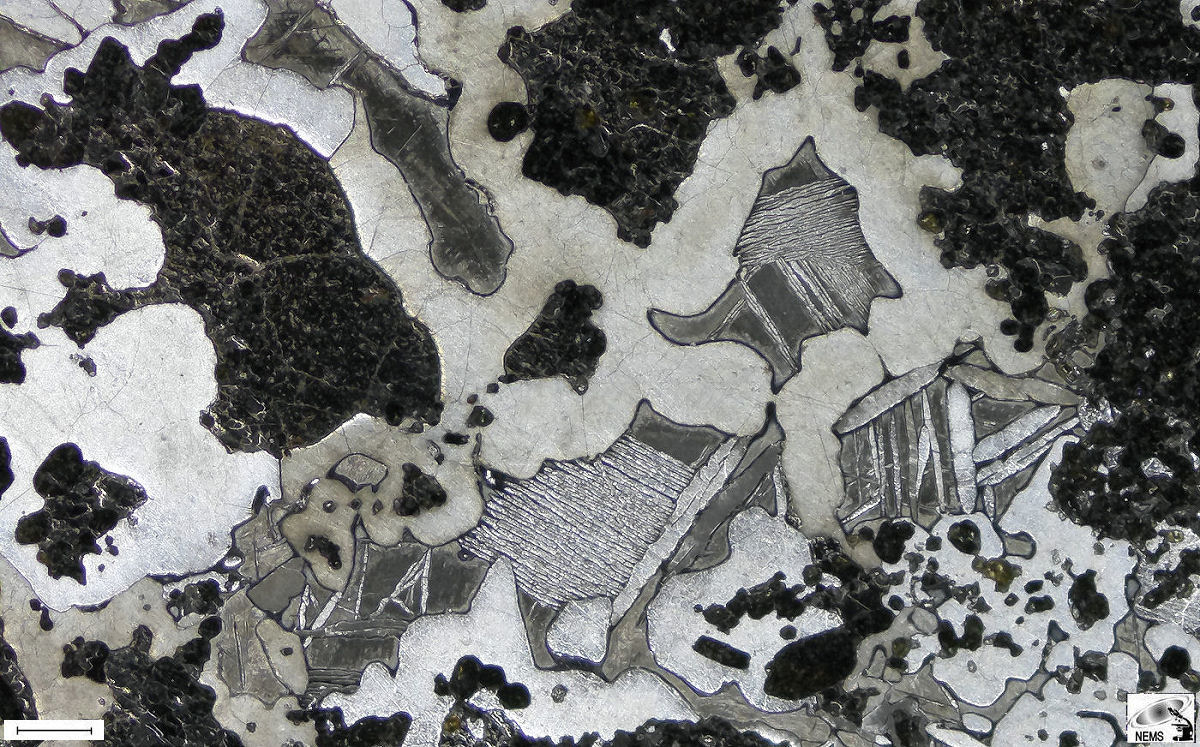 |
| Figure 1. |
| Swathing kamacite in the Maslyanino iron meteorite (IAB complex), precipitated around taenite, schreibersite, and plessitic fields. Scale bar=1 mm. |
| Meteorite: Maslyanino (IAB
Iron) Formation and Petrogenesis Swathing kamacite refers to rims or envelopes of kamacite (low-Ni a-FeNi) that form around non-metallic inclusions or along interfaces during the cooling of iron meteorites. It develops through solid-state diffusional transformations in the Fe-Ni system, typically nucleating on heterogeneous sites such as troilite (FeS), schreibersite ((FeNi3P), chromite (FeCr2O4), or silicate inclusions. These phases act as preferential nucleation substrates due to local compositional gradients, interfacial energy minimization, and lattice mismatch effects. The process begins in the later stages of primary cooling, near ~725°C in the Fe-Ni-P system (close to relevant eutectoid or peritectic reactions). At this stage, Ni diffuses from the surrounding taenite (γ-FeNi) toward the inclusion or interface, stabilizing kamacite precipitation and forming continuous or semi-continuous rims. These swathing layers typically reach widths of 0.5–2 mm, depending on cooling rate, bulk composition, and inclusion size. Swathing kamacite may also develop along primary taenite grain boundaries. As cooling continues with a further temperature drop of ~50–100°C, the Widmanstätten pattern (oriented kamacite lamellae exsolved from taenite) begins to nucleate and grow outward from the swathing rims. This growth persists down to approximately 450–500°C, below which bulk diffusion effectively ceases on geological timescales. The resulting microstructure records a clear temporal sequence: swathing kamacite forms first as a secondary feature, followed by the development of the Widmanstätten intergrowth. Phosphorus Behavior and Associated Phases During the critical cooling interval (~725–500°C), phosphorus—highly soluble in taenite at higher temperatures—becomes supersaturated and exsolves. This leads to precipitation of schreibersite at structural interfaces (including swathing kamacite boundaries) and as prismatic rhabdites within kamacite lamellae. These phosphide phases provide important petrographic markers for reconstructing thermal histories and are discussed in greater detail elsewhere in this series (e.g., p. 40). Example: Maslyanino (IAB Complex Iron) The Maslyanino meteorite, a member of the IAB complex (non-magmatic irons often linked to impact-melt or chondritic parent-body processes), illustrates well-developed swathing kamacite. In Figure 1, kamacite rims envelop taenite domains, schreibersite grains, and plessitic fields. IAB-complex irons like Maslyanino typically exhibit slower or more variable cooling rates (commonly 10–35 °C/Myr) compared to many magmatic groups, allowing pronounced development of such secondary structures alongside diverse inclusions. Classification and Broader Significance Swathing kamacite is classified as a secondary structure because it postdates initial metal crystallization and reflects subsolidus re-equilibration. Its presence and morphology are sensitive to cooling rate, shock history, and local chemistry. In many irons, swathing kamacite indicates equilibrium nucleation on inclusions during slow cooling in the parent body’s interior. Detailed study of swathing kamacite contributes to quantitative metallography: rim widths, combined with kamacite bandwidths and plessite textures, help constrain metallographic cooling rates (typically 1–100+ °C/Myr for many magmatic iron groups at ~500°C). In ungrouped or complex irons, deviations from expected patterns may signal impact reheating, brecciation, or sampling of heterogeneous parent-body regions. Thus, swathing kamacite serves as a key petrographic tool for deciphering the multistage thermal and collisional evolution of asteroidal metallic cores. High-resolution techniques such as electron probe microanalysis (EPMA), scanning electron microscopy (SEM), and electron backscatter diffraction (EBSD) further reveal orientation relationships and diffusion profiles, enhancing models of Fe-Ni-P phase equilibria in extraterrestrial metals. |
| References • Buchwald, V. F. (1975). Handbook of Iron Meteorites. University of California Press / Center for Meteorite Studies. • Buchwald, V. F. (1977). The mineralogy of iron meteorites. Philosophical Transactions of the Royal Society A, 286(1336), 453–491. • Goldstein, J. I., et al. (various). Works on cooling rates and Fe-Ni diffusion modeling in iron meteorites. • Meteoritical Bulletin Database: Maslyanino. • New England Meteoritical Services. (2023). Swathing Kamacite (Primary and Secondary Structures documentation). • Ponomareva, D. S., et al. (2019). The Maslyanino Iron Meteorite with Silicate Inclusions: Mineralogical and Geochemical Study and Classification Signatures. Russian Geology and Geophysics |
| Listing of Structures |